How To Choose A Hydraulic Cylinder: Bore, Stroke, Pressure And Mounting
Release time:2026-11-16 Visits:0
Buying a
hydraulic cylinder comes down to a handful of numbers. If you can answer five questions — force, stroke, pressure, mounting, environment — you can specify a cylinder that works the first time. This guide walks through each one, with the calculations you need and the mistakes that cost people money.
Start with the Force and the Bore
Decide the force the cylinder must produce, then work backwards with the basic formula: F = P × A. Force in newtons equals pressure in pascals times the piston area in square metres. In practical units: choose a working pressure, say 160 bar (16 N/mm²), and divide the required force by it to get the piston area, then the bore diameter.
Worked example: you need 80 kN at 160 bar. Area = 80,000 N ÷ 16 N/mm² = 5,000 mm². Bore = √(5,000 × 4 ÷ π) ≈ 80 mm. You would then step up to the next standard bore size — and add a safety margin, because the calculation so far ignores friction, pressure drop and wear.
Stroke and Buckling
Stroke is the travel you need, plus end clearance and cushioning. Long strokes change the problem completely: a long, slender rod under compression buckles long before it yields. Check the rod against the buckling load curves — Euler's formula for slender columns, or the manufacturer's load-stroke charts — for the actual extended stroke, not just the working load. A cylinder that is perfect on paper can still bend its rod on the first push if this step is skipped.
Working Pressure and Safety Margin
Match the cylinder rating to the system pressure, but remember what happens in a real circuit: relief valves overshoot, inertia adds peak loads, and worn pumps ripple. A cylinder rated exactly at nominal pressure with no margin is a cylinder waiting to leak — or worse. A 10–20% margin above the calculated worst case is common practice, and standards for pressure vessels are stricter still.
Mounting Styles
Flange mount — stiff and predictable; the load path goes straight through the cylinder axis.
Foot mount — simple and popular, but side loads and bending pass into the barrel.
Clevis and trunnion mounts — allow the cylinder to pivot and follow the machine's motion; they forgive misalignment.
Tie-rod front/rear mounts — common on industrial cylinders; the mount carries through the tie rods.
Pick the mount that matches the machine's actual motion. A rigid mount on a pivoting joint is how barrels get bent and seals get scored.
Seals and Environment
Seal material follows the fluid and the temperature: NBR for mineral oil at moderate temperatures, polyurethane for wear resistance, PTFE for low friction and high speed, FKM for heat and aggressive fluids. Wipers matter outdoors, stainless rod and barrel help in washdown and marine duty, and a foundry or a food plant changes the specification entirely. Say where the machine runs before you buy, not after.
Rod and Barrel Materials
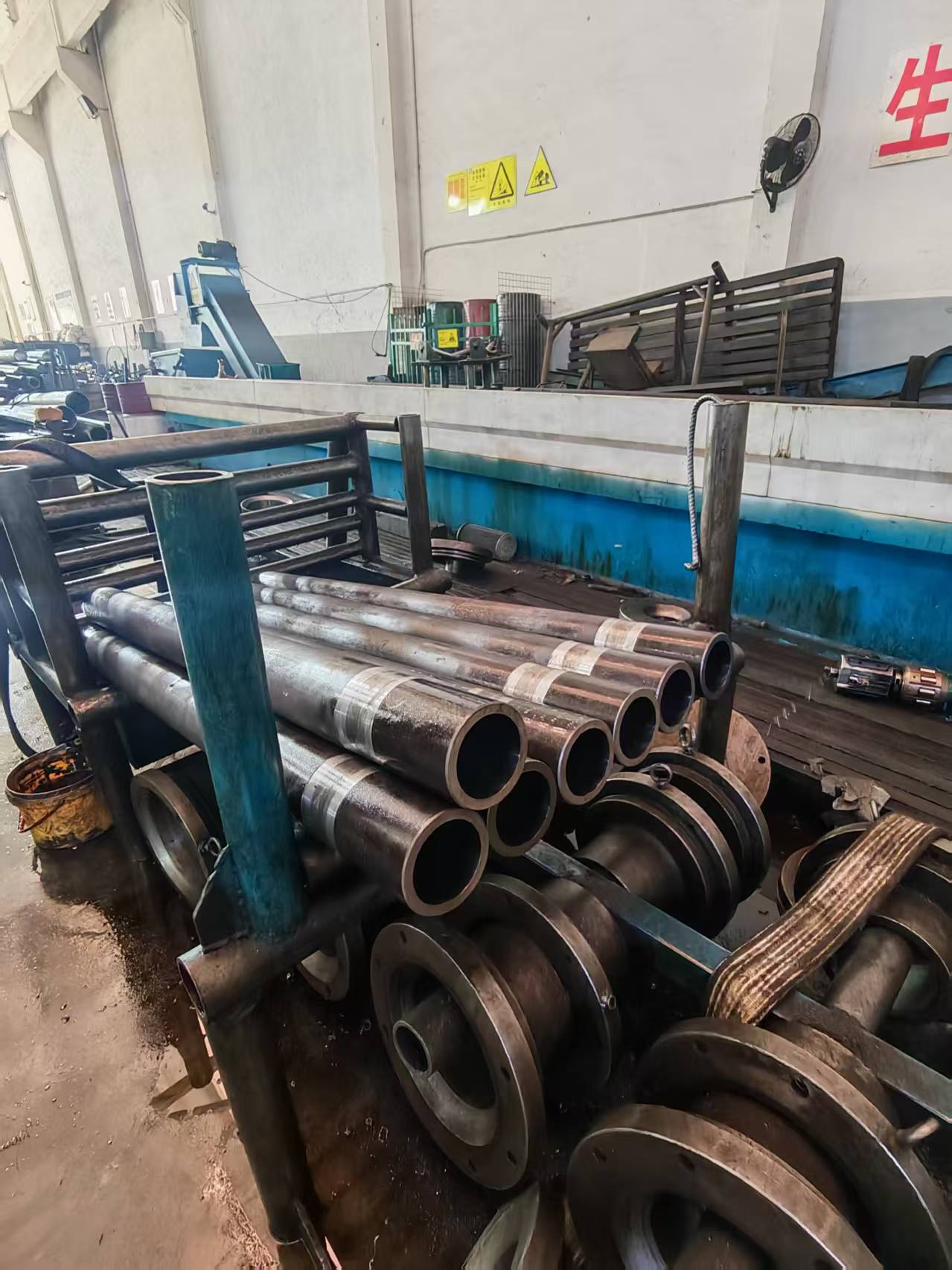
Rod: hard chrome on medium-carbon steel is the default; induction-hardened rods for abrasive duty; stainless for corrosion. Barrel: carbon steel seamless for general industrial use; alloy steel such as 27SiMn, 35CrMo and 42CrMo for high pressure and lighter weight; stainless for food, pharmaceutical and chemical applications.
Red Flags When Buying a Hydraulic Cylinder
No material certificates or test reports with the delivery
Vague tolerances on bore and rod diameter
A high-pressure barrel made from welded pipe, undisclosed
No straightness or roundness data for long-stroke cylinders
A price dramatically below everyone else's — someone is paying for it somewhere
FAQ
Q: How do I calculate the force of a hydraulic cylinder?
Force = pressure × piston area. At 160 bar, a 100 mm bore gives about 125 kN of theoretical push. Subtract friction (usually 5–10%) for the real usable force.
Q: What is the next standard bore size after 80 mm?
Common metric bores run 80, 100, 125, 140, 160 mm and up. Choose the standard size above your calculated value — custom bores cost more and buy little.
Q: How much pressure margin should I allow?
A 10–20% margin over the calculated worst case is typical. For shock-loaded or high-cycle machines, go higher and check the peaks with a pressure gauge.
Q: Can Tengye help me select and build the right cylinder?
Yes. Send the load, stroke, pressure and mounting requirements — the factory will size the cylinder, choose materials and seals, and build it in-house.
Not sure which cylinder fits your machine? Send the duty data to
Tengye Machinery and get a straight answer — +86 18912360300.