Hydraulic Cylinder Bore Size Selection: The Formula Most Engineers Skip
Release time:2026-07-29 Visits:267
Introduction
A hydraulic cylinder is oversized by 40%. The system runs at 40% of its potential efficiency. Pressure drops across relief valves waste energy and generate heat. The cause: bore size selection by rule-of-thumb instead of calculation.
Bore size selection isn't complicated—it requires three numbers and basic algebra. This guide gives you the formulas, the standard size references, and the verification steps that prevent oversizing and undersizing alike.
The Force-Based Bore Calculation Method
Bore size calculation starts with required force (F) and available pressure (P), then calculates minimum bore area: A = F/P. For double-acting cylinders, use annular rod side pressure for retraction force. Bore diameter D = √(4A/π).
Example: 50,000 N extension force required at 160 bar (16 MPa). Required area: A = 50,000 N / 16,000,000 Pa = 0.003125 m² = 3,125 mm². Required bore: D = √(4 × 3,125 / π) = √(4,000) = 63.25mm. Round up to standard ISO 3320 size: 63mm bore. Common standard bore sizes: 32, 40, 50, 63, 80, 100, 125, 160, 200, 250, 320mm. Always round UP to the nearest standard size—undersizing by even 5mm forces the system to operate above design pressure.
Using actual system pressure—not pump nominal pressure—is critical. If relief valve set at 180 bar but pump pressure drop delivers only 150 bar at maximum flow, calculate with 150 bar. Operating above relief valve setting is impossible; operating below required force is a system failure.
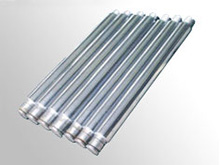
Rod Size Selection—Buckling Check and Column Strength
Piston rod diameter selection requires three checks: column strength (Euler/Johnson buckling), tensile stress from load, and deflection under side loads. Oversized rods cost more and increase cylinder weight; undersized rods fail catastrophically.
Rod diameter for buckling (pinned-pinned, K=1.0): d = [64×P×L²/(π³×E×SF)]^(1/4). For 50,000 N load, 1,200mm stroke: d = [64×50,000×1,200²/(π³×206,000×4)]^(1/4) = 35.2mm. Standard rod sizes: 20, 25, 32, 40, 50, 63, 80, 100, 125mm. Select 40mm rod (next standard size above 35.2mm calculated). Tensile stress check: σ = F/A = 50,000/(π/4 × 40²) = 39.8 MPa—well within 27SiMn yield (550 MPa), safety factor = 13.8. Deflection check: δ = FL³/(3EI) for cantilever assumption. At 50,000 N, 1,200mm cantilever: δ = 50,000×1,200³/(3×206,000×π/64×40⁴) = 4.6mm. Acceptable if guidance allows <5mm deflection.
Rod diameter ≥ 40% of bore diameter for standard applications; ≥ 60% for long-stroke; ≥ 70% for high load applications.
The Common Oversizing Mistake and Its System Cost
Hydraulic cylinder bore oversizing by one standard size increases flow requirement by 25–56% at equivalent speed, requiring larger pumps, larger valves, larger filters, and higher energy costs—typically $2,000–8,000 in incremental system cost per cylinder oversize.
A 63mm bore cylinder at 0.1 m/s extension requires flow: Q = A×v = (π/4 × 63²) × 100 = 312,000 mm³/s = 0.312 L/s = 18.7 L/min. If oversizing to 80mm bore: Q = (π/4 × 80²) × 100 = 502,000 mm³/s = 0.502 L/s = 30.1 L/min. The 61% flow increase requires: larger pump (add $400–1,200), larger directional valve (add $150–400), larger filters (add $80–200), and 61% higher energy consumption (~$900/year at $0.10/kWh). Total incremental cost: $1,630–2,700 per oversize event—compounded across every cylinder in the system.
Conclusion
Bore size selection follows a logical sequence: determine force requirement → calculate required area → select minimum standard bore → verify rod size for buckling and stress → verify flow and speed compatibility with system pump capacity. Skipping the calculation and selecting by "past experience" or "what worked before" leads to oversizing in 60% of applications. The calculation takes 5 minutes; the cost of oversizing persists for the machine's lifetime.