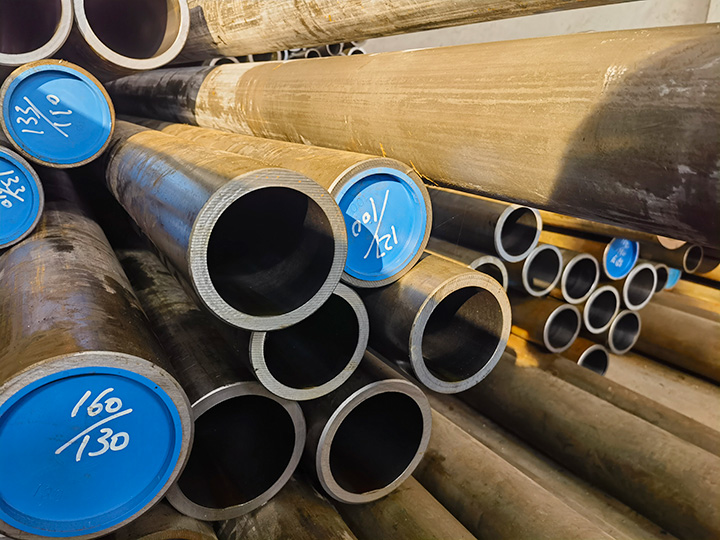
Cold drawn steel pipes are high-precision, high-performance steel pipe products manufactured by cold drawing process on the basis of hot-rolled steel pipes. Through plastic deformation under room temperature conditions, the pipes achieve precise dimensional control, smooth surface quality, and enhanced mechanical properties, which are significantly superior to traditional hot-rolled steel pipes. As a key structural and functional component, cold drawn steel pipes are widely used in automotive, hydraulic, petroleum, aerospace, machinery manufacturing and other industrial fields. Their application effect directly affects the reliability, precision and service life of equipment and engineering projects. With the continuous development of industrial technology towards high precision, lightweight and high efficiency, the application scope of cold drawn steel pipes is constantly expanding, and higher requirements are put forward for their performance and customization level.
1. Core Definition and Performance Characteristics of Cold Drawn Steel Pipes
Cold drawn steel pipes refer to steel pipe products processed by cold drawing process, which uses a drawing die to apply external force to the hot-rolled steel pipe blank at room temperature, making the blank pass through the die hole to achieve plastic deformation, thereby obtaining the required diameter, wall thickness and surface quality. Different from hot-rolled steel pipes, cold drawn steel pipes do not need high-temperature heating during processing, which avoids the problems of grain coarsening, surface oxidation and dimensional deviation caused by high temperature, and has unique performance advantages.
The core performance characteristics of cold drawn steel pipes are reflected in four aspects: first, high dimensional precision. The outer diameter tolerance can be controlled within ±0.02mm, the wall thickness tolerance within ±0.01mm, and the ovality is less than 0.03mm/m, which can meet the assembly requirements of high-precision equipment. Second, excellent surface quality. The surface roughness Ra is controlled within 0.2-0.8μm, without defects such as oxide scale, scratches and pits, and no additional surface processing is required in most application scenarios. Third, enhanced mechanical properties. After cold drawing, the grain structure of the steel pipe is refined, the tensile strength is increased by 20%-30% compared with hot-rolled pipes, the yield strength is increased by 30%-40%, and it has good toughness and wear resistance. Fourth, good uniformity. The performance of each part of the cold drawn steel pipe is uniform, the metallographic structure is dense, and there is no obvious internal defect, which ensures the stability of its service performance.
2. Classification of Cold Drawn Steel Pipes and Selection Basis
According to different classification standards, cold drawn steel pipes can be divided into multiple types, and the selection of types is closely related to application scenarios, working conditions and performance requirements. Reasonable classification and selection are the key to ensuring the application effect.
2.1 Classification by Material
According to the material, cold drawn steel pipes are mainly divided into carbon steel cold drawn pipes and alloy steel cold drawn pipes. Carbon steel cold drawn pipes are made of Q235, 10#, 20#, 45# and other carbon structural steels, which have the advantages of low cost, good plasticity and easy processing, and are suitable for general load-bearing and conveying scenarios. Alloy steel cold drawn pipes are made of 42CrMo, 35CrMo, 20CrMnTi and other alloy structural steels, which have higher strength, hardness and corrosion resistance after cold drawing and heat treatment, and are suitable for harsh working environments such as high pressure, high temperature and corrosion.
2.2 Classification by Cross-Section Shape
According to the cross-section shape, cold drawn steel pipes can be divided into circular cold drawn pipes and special-shaped cold drawn pipes. Circular cold drawn pipes are the most widely used type, with uniform stress distribution, easy processing and assembly, and are widely used in hydraulic systems, pipelines and other fields. Special-shaped cold drawn pipes include square, rectangular, hexagonal, elliptical and other cross-sections, which are customized according to the structural needs of equipment, and are mainly used in automotive parts, machinery components and other scenarios that require special structural shapes.
2.3 Classification by Application Purpose
According to the application purpose, cold drawn steel pipes can be divided into structural cold drawn pipes, hydraulic cold drawn pipes, conveying cold drawn pipes and precision cold drawn pipes. Structural cold drawn pipes are used for load-bearing components such as machine tool guide rails and support shafts; hydraulic cold drawn pipes are used for hydraulic cylinders, hydraulic pipelines and other components in hydraulic systems; conveying cold drawn pipes are used for conveying gas, liquid and other media; precision cold drawn pipes are used for high-precision components such as aerospace parts and precision instruments.
3. Application of Cold Drawn Steel Pipes in Key Industrial Fields
Due to their excellent performance, cold drawn steel pipes have become indispensable core components in many industrial fields, and different fields have different application requirements and application forms for cold drawn steel pipes.
3.1 Application in Hydraulic and Pneumatic Systems
Hydraulic and pneumatic systems are the most important application fields of cold drawn steel pipes, accounting for more than 40% of the total application of cold drawn steel pipes. In hydraulic systems, cold drawn steel pipes are mainly used as hydraulic cylinder barrels, piston rods, hydraulic pipelines and other components. Due to the high dimensional precision and smooth surface of cold drawn steel pipes, they can effectively reduce the friction between the piston and the cylinder barrel, improve the sealing performance of the hydraulic system, and avoid internal leakage of hydraulic oil. The hydraulic cold drawn pipes used in engineering machinery and metallurgical equipment usually adopt 42CrMo alloy steel, with a rated working pressure of 20-40MPa, and the inner hole is processed by honing technology to further improve the surface precision. In pneumatic systems, cold drawn steel pipes are used as air pipelines, which have good air tightness and pressure bearing capacity, and can ensure the stable operation of the pneumatic system.
3.2 Application in Automotive Industry
The automotive industry is another key application field of cold drawn steel pipes, which are widely used in engine components, chassis components, transmission systems and other parts. In the engine, cold drawn steel pipes are used as camshafts, crankshafts, oil pipes and other components, requiring high precision, high strength and good wear resistance. For example, the camshaft made of 20CrMnTi cold drawn steel pipe has a surface hardness of HRC 58-62 after carburizing and quenching, which can effectively improve the service life of the engine. In the chassis, cold drawn steel pipes are used as shock absorber cylinders, steering rods and other components, which have good toughness and fatigue resistance, and can withstand the impact and alternating loads during the operation of the vehicle. In addition, cold drawn steel pipes are also used in automotive exhaust systems, with good high temperature resistance and corrosion resistance, which can adapt to the high temperature exhaust gas environment.
3.3 Application in Petroleum and Natural Gas Industry
In the petroleum and natural gas industry, cold drawn steel pipes are mainly used for oil and gas conveying pipelines, well casings and downhole tools. The oil and gas conveying pipelines made of cold drawn steel pipes have high pressure bearing capacity, good corrosion resistance and smooth inner wall, which can reduce the resistance of oil and gas conveying and improve the conveying efficiency. For offshore oil and gas fields, cold drawn steel pipes with anti-corrosion treatment (such as galvanizing, epoxy coating) are used, which can resist the corrosion of seawater and harsh marine environment. The well casings made of cold drawn steel pipes have high strength and wear resistance, which can protect the well wall and ensure the normal drilling and production of oil and gas wells. In addition, cold drawn steel pipes are also used in downhole tools such as drill pipes and sucker rods, which require good fatigue resistance and corrosion resistance to adapt to the complex downhole environment.
3.4 Application in Aerospace and Precision Machinery
In the aerospace industry, cold drawn steel pipes are used for aircraft landing gear components, engine pipelines, fuel pipelines and other high-precision components. Due to the strict requirements of aerospace equipment on weight, precision and reliability, cold drawn steel pipes used in this field usually adopt high-strength alloy steel, with high dimensional precision (outer diameter tolerance ±0.01mm), low weight and good fatigue resistance. For example, the landing gear rod made of cold drawn steel pipe has a tensile strength of more than 1200MPa, which can withstand the impact load during aircraft take-off and landing. In precision machinery, cold drawn steel pipes are used for machine tool guide rails, precision shafts, measuring instruments and other components, which have high precision and good stability, and can ensure the processing accuracy and service life of precision machinery.
3.5 Other Application Fields
In addition to the above fields, cold drawn steel pipes are also widely used in construction, medical equipment, food machinery and other fields. In the construction field, cold drawn steel pipes are used as steel structure supports, decorative pipes and other components, which have good strength and aesthetics; in the medical equipment field, cold drawn steel pipes are used as medical instruments such as surgical instruments and medical catheters, requiring high precision and biocompatibility; in the food machinery field, cold drawn steel pipes are used as conveying pipes and processing components, which have good surface quality and corrosion resistance, and can meet the hygiene requirements of food processing.
4. Technical Advantages of Cold Drawn Steel Pipes in Application
Compared with traditional hot-rolled steel pipes and other pipe materials, cold drawn steel pipes have obvious technical advantages in industrial applications, which are the key reasons for their wide application.
First, the comprehensive performance is excellent. The cold drawing process refines the grain structure of the steel pipe, improves the strength, hardness and toughness of the steel pipe, and makes it have better wear resistance, corrosion resistance and fatigue resistance, which can adapt to various harsh working environments. Second, the dimensional precision is high. The cold drawing process can accurately control the diameter, wall thickness and ovality of the steel pipe, reducing the subsequent processing steps and improving the production efficiency of equipment and engineering. Third, the surface quality is good. The surface of the cold drawn steel pipe is smooth and free of defects, which can reduce the friction loss between components, improve the sealing performance and service life of the system. Fourth, the customization is strong. According to the different needs of application scenarios, cold drawn steel pipes can be customized in terms of material, cross-section shape, size and performance, which has strong adaptability. Fifth, the cost performance is high. Although the production cost of cold drawn steel pipes is slightly higher than that of hot-rolled steel pipes, their long service life, low maintenance cost and high efficiency in application make them have higher cost performance in the long run.
5. Application Challenges and Development Trends
With the continuous upgrading of industrial technology, cold drawn steel pipes are facing new application challenges and development opportunities. In terms of application challenges, on the one hand, the high-precision and high-performance requirements of emerging fields such as aerospace and new energy put forward higher requirements for the dimensional precision, mechanical properties and corrosion resistance of cold drawn steel pipes; on the other hand, the environmental protection requirements of the industry are increasing, and the cold drawing process needs to be optimized to reduce energy consumption and environmental pollution.
In response to these challenges, the development trends of cold drawn steel pipes in application are mainly reflected in four aspects: first, high precision and high performance. The development of ultra-precision cold drawing technology will further improve the dimensional precision and mechanical properties of cold drawn steel pipes, meeting the needs of high-end equipment. Second, green and low-carbon. The optimization of cold drawing process (such as energy-saving drawing equipment, environmentally friendly lubricants) will reduce energy consumption and environmental pollution, realizing green production. Third, material diversification. The development and application of new materials (such as high-strength stainless steel, composite materials) will expand the application scope of cold drawn steel pipes, adapting to more harsh working environments. Fourth, integration of processing and application. The integration of cold drawing processing and subsequent heat treatment, surface treatment and other processes will improve the production efficiency and product quality, and provide integrated solutions for industrial applications.
In conclusion, cold drawn steel pipes, as high-precision and high-performance pipe products, play an irreplaceable role in various industrial fields. With the continuous innovation of cold drawing technology and the expansion of application fields, cold drawn steel pipes will move towards the direction of high precision, high performance, greenization and customization, providing strong support for the high-quality development of the industrial field. In the future, the research focus will be on improving the processing technology, developing new materials and expanding the application scope, so as to better meet the increasingly high application requirements of various industries.